
Last Updated on April 25, 2026 by Dr. Ashley Söderlund
This is a fun game we play in our house that has the benefit of hands-on fun with basic math principles, cognitive skills, and self-regulation.
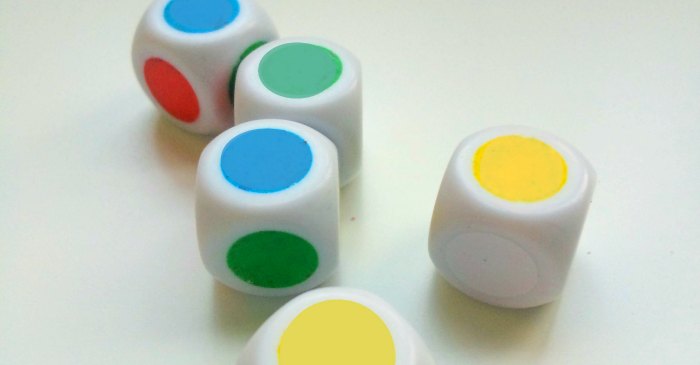
We saw a similar game for children in Sweden, but I’ve searched for one here and can’t find it. If you live in Sweden, you can buy this version: Barn Yatzy. Below is my version of this fun game! It is a basic dice game in which kids identify patterns and count colors. There are also points which are tallied. Older children can help with the points and younger children observe the process of accumulating and adding points together.
For preschoolers (who are in Piaget’s Preoperational stage of development) learning should be hands-on and gamelike. Playing games with preschoolers has the added bonus of practicing self-regulation skills. Waiting for their turn, not rolling the dice too hard, following the rules of the game — these are all natural situations in which children must regulate one behavior in order to meet a higher goal (i.e. I want to throw the dice across the room but I won’t because I want to play the game more). For other great games see my post on My Favorite Games for Fostering Self-Regulation.
To learn numeracy children need to manipulate objects. They move from this concrete exploration to thinking more abstractly over time. I love this game because it incorporates both concrete and abstract mathematical ideas. Also, it asks children to identify patterns, a key building block for math and science education.
The other thing I love about this game is you can play it in about 15 minutes, so it can hold a preschooler’s attention. Although, it’s also okay not to play the full ten rounds. We started playing this game with my son when he was about 3.5 years old. It took a few times introducing it to get him into it, but once he got it he loved it!
Here are the rules of the game.
Object:
2-6 players
Players take turns rolling 5 colored dice. The goal is to get as many matches as possible. If all 5 dice are the same color that is the highest score (see the printable for other combinations and point values).
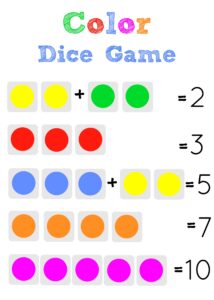 For a printable version click this link Color Dice Game Scoring Sheet.
Process:
On their turn, a player can roll the dice three times. The first roll includes all 5 dice. If there are two dice that match the player can put those to the side and roll the remaining three dice. A player can reroll any number of dice.
Points are tallied for each round. There are ten rounds, but you could choose to do five rounds if you wanted a shorter game.
Whoever has the most points wins!
Materials:
I’ve created two free printables! One with the possible patterns and assigned points and a score tally sheet. I laminated ours and we use a dry erase marker for the tally sheet, so you only need to print one. If you don’t have a set in another game you will also need to purchase a set of colored dice. Here is the set we have (affiliate link): Color Dot, 6-Sided Novelty Dice _ Bundle of 12 Identical Dice .For a printable version click on this link
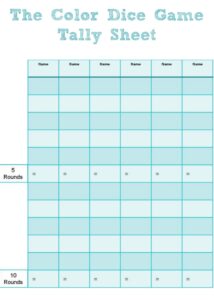
For a printable version click on this link Color Dice Game Tally Sheet.
On the color dice printable I don’t include all possible patterns with all possible colors. This is because I want to encourage flexible thinking. Cognitive flexibility (great video in that link) is the ability to switch from one set of rules to another. This is an executive function skill that develops across the preschool period. For example, I want my son to be able to understand that it isn’t two yellows and two reds that equal 2 points, but that it is any pair of matching colors. That requires a little bit of abstract thinking and cognitive flexibility and it is beyond simple concrete manipulation.
Happy playing!


 How to Encourage Independent and Creative Play
Thank you so much for linking the #pinitparty
Great activity! Thank you so much for linking the #pinitparty