Last Updated on July 2, 2026 by Dr. Ashley Söderlund
Understanding and expressing feelings is crucial for children’s emotional development and well-being. A powerful tool that aids children in this process is the feelings wheel. This visual aid helps children recognize and label their emotions and empowers them to communicate, regulate, and understand their feelings better.
The Importance of Emotion Regulation
One of the most important skills children learn in their early years is emotion regulation. During the first several years of life, young kids have experiences with parents, siblings, and peers that help shape the parts of the brain that regulate emotions. Those brain systems are still under construction throughout the early years.
Emotion regulation is a foundational life skill that enables us to recognize, understand, and manage our emotions and those of others. Emotional regulation is a foundation for healthier relationships, a strong sense of self, and overall well-being for children.
The first step is learning to identify different emotions. The printable emotion wheel is a fun way to help young children learn specific feelings. This understanding helps children realize that feelings are natural and temporary, leading to healthier emotional responses, better coping skills, and behavior.
The Feelings Wheel for Kids: A Colorful and Visual Tool
Young children do not have the vocabulary to name their emotions. Also, emotions are abstract and hard to describe. Using a colorful, intuitive visual tool like the feelings wheel helps make it easier to describe big feelings. This is a building block for learning coping strategies for big emotions.
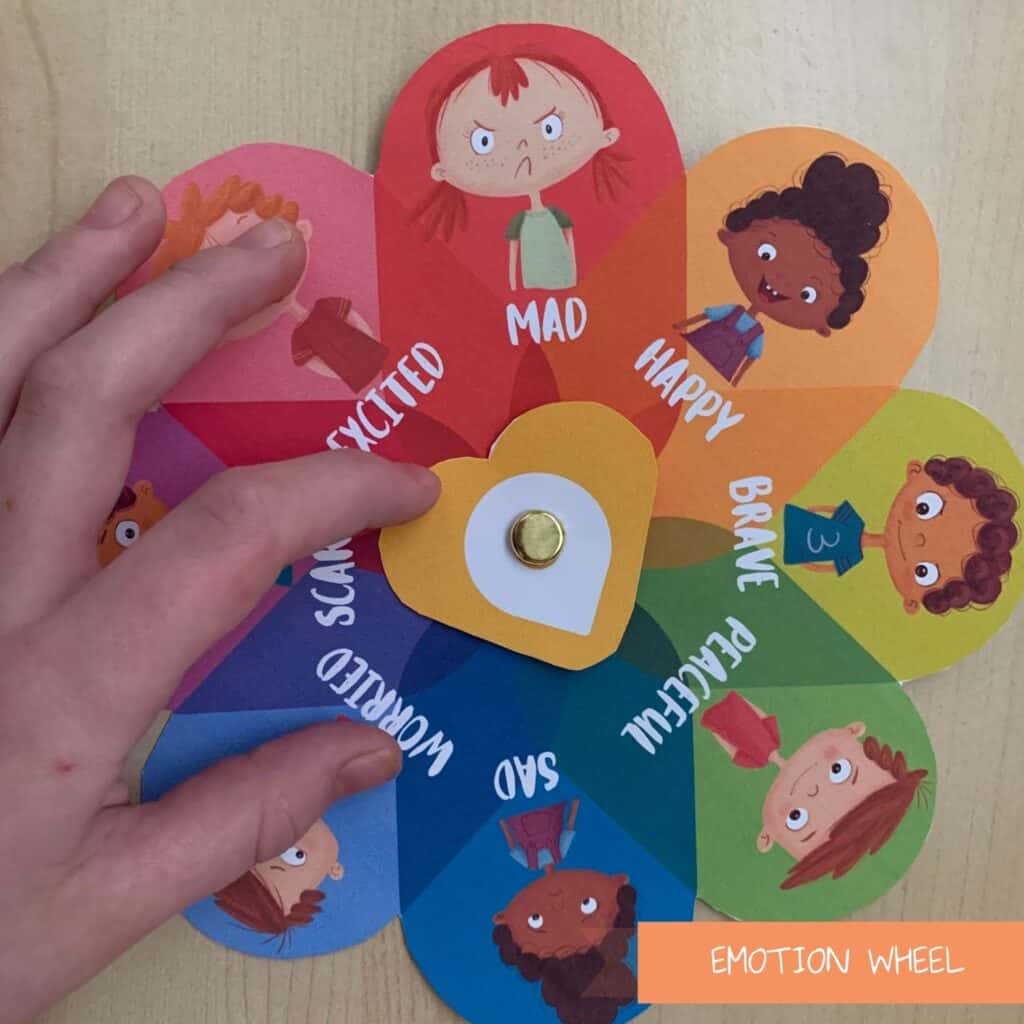
Each emotion in the feelings wheel is depicted through distinct colors and categories, making it easier for kids to associate their feelings with visual cues. This helps build their emotional vocabulary and enhances their ability to express themselves. The wheel of emotions contains primary emotions as well as secondary, self-conscious emotions: Happy, Sad, Mad, Scared, Worried, Excited, Brave, and Peaceful.
Feelings are meant to be felt and experienced. Too often our world teaches children to avoid or ignore their feelings. When we give children the space to feel, we are building a foundation of strong mental health.
Ashley Soderlund, Ph.D.
How to Use the Feelings Wheel
Download the free feelings wheel printable below. This feeling wheel is part of my Mindful Emotions Toolkit, which contains printable resources like emotion thermometers, specific emotion cards, and regulation cards. You can make this fun craft to do with your kids! Cut out the wheel and the heart-shaped arrow. Use a metal fastener to attach the heart-shaped arrow to the wheel.
Ask your child to describe what it feels like in their body when they feel happy, excited, or proud. Move the heart-shaped arrow to each emotion as you talk about them. Then ask your child about other feelings, like how they feel inside when they feel sad or mad. Do this at a time when your child is calm and not feeling any big emotions. Tell your child it is good to talk about our emotions and feelings inside our bodies.
When your child has a big emotion, hand them the feeling wheel and ask them to find the one showing their feelings. Encourage your child to describe that feeling and the sensations that go along with it. Acknowledge what your child feels by repeating it to them, i.e., “You feel mad.”
This is a significant first step in developing healthy coping skills. By helping your child label their feelings, you also show that you acknowledge and accept their emotions. This teaches children they can face their feelings instead of avoiding them.
Remember, regulating emotions isn’t about trying to avoid negative emotions. Positive emotions like excitement and silliness sometimes need to be modulated, just like anger and frustration do. Things like silly venting (see the regulation cards in the Mindful Emotions Toolkit for examples) can help healthily release pent-up emotions.
For more resources and how to build on this first step in building your child’s emotional intelligence, see these articles: