
Last Updated on July 1, 2026 by Dr. Ashley Söderlund
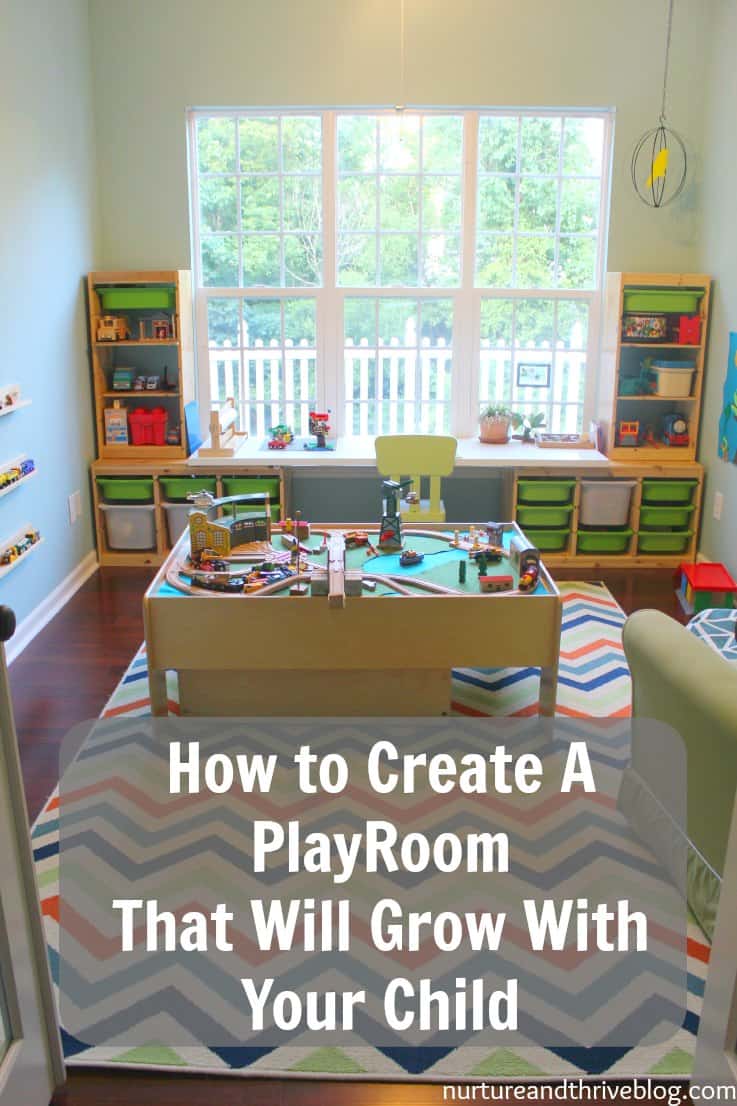
One of the reasons we fell in love with our current home is that it has a bonus room right off the living and kitchen area. It is a smaller bonus room than the ones you sometimes see on the second level of some homes or a basement recreation room, but I thought it would be perfect for a family playroom that would grow with our son.
I spent hours looking at playroom ideas online. What I really wanted for that space was a playroom my son would use year after year with good toy storage.
My goal was to create a space that would be functional for creative play, homework, toy organization, and hanging out with friends.
Looking for a play area for your baby that fits right in your living room instead? I put together a full guide on how to create a baby play area that’s both developmentally rich and parent-friendly — no bonus room required.
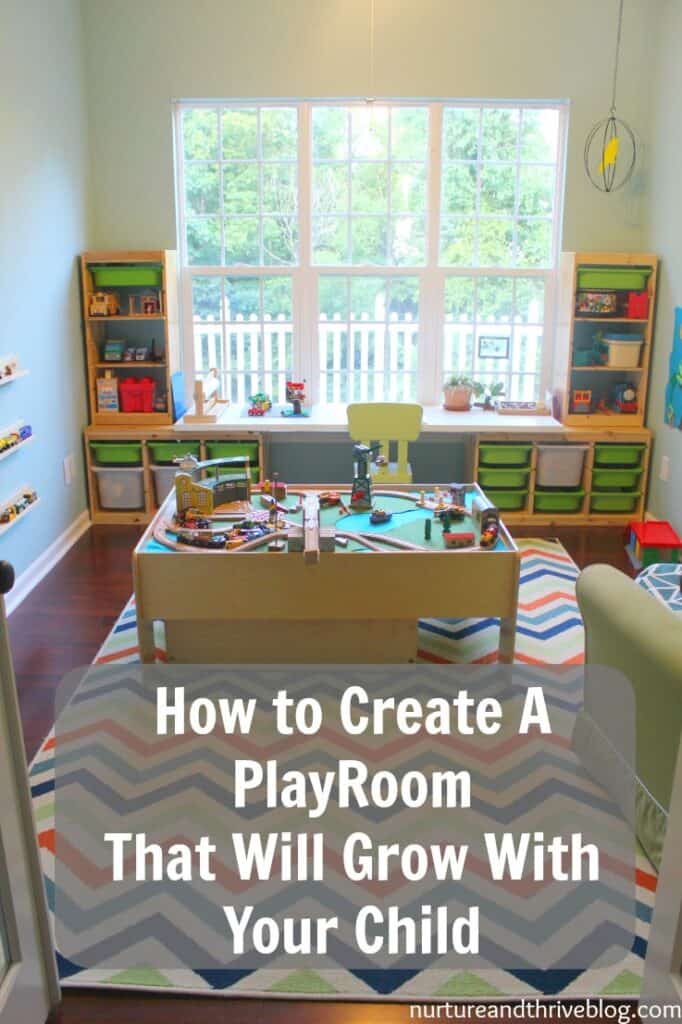
3 Playroom Ideas and Areas that Will Grow with Your Child
1. Invest in toys that will grow with your child.
Think about your child’s interests — which toys or activities will they love for years to come? My son was three when I designed this space. He loves “going things” and building things.
For his interest in “going things,” we have a train table with easily accessible trains and tracks. The older he gets (he just turned 4), the more he designs the tracks himself (See more on the train wall organizer here).
Because of his interest in building things, I wanted to store bricks and blocks in a way that would be easy to organize and find, even those tiny pieces.
The IKEA TROFAST toy storage units (Amazon link here) work great for this. Now, those drawers hold bricks, blocks, cars, trucks, and other things.
As he grows, I imagine it will be taken over by school supplies, Legos, science kits, rock collections, model planes, and Erector sets.
2. Create an Open-Workspace.
We attached the IKEA LINNMON table top to two of the IKEA TROFAST storage units to create a desk space (thanks to my Husband, who is Swedish and grew up building Ikea furniture, it’s like second nature to him!).
For extra storage, we attached two of the narrow TROFAST units with shelves on either end.
In preschool, he used this space for art projects, Lego projects, building cities, playdough, kinetic sand, puzzles, and so on.
As he grows, I imagine more complicated Lego, art projects, and homework happening at this desk (and he did—see it now!).
Right now, the desk is about 22″ high, which is really about right for the average first-grader, and it works well with this chair. It works for my son now (who is tall for his age), but I also think he has some room to grow into it.
The LINNMON table top is also easy to clean. In a few of these pictures, you may see some crayon marks. There has been much worse on this table, and a magic eraser has taken it all right off! All of the components of this workspace are anchored.
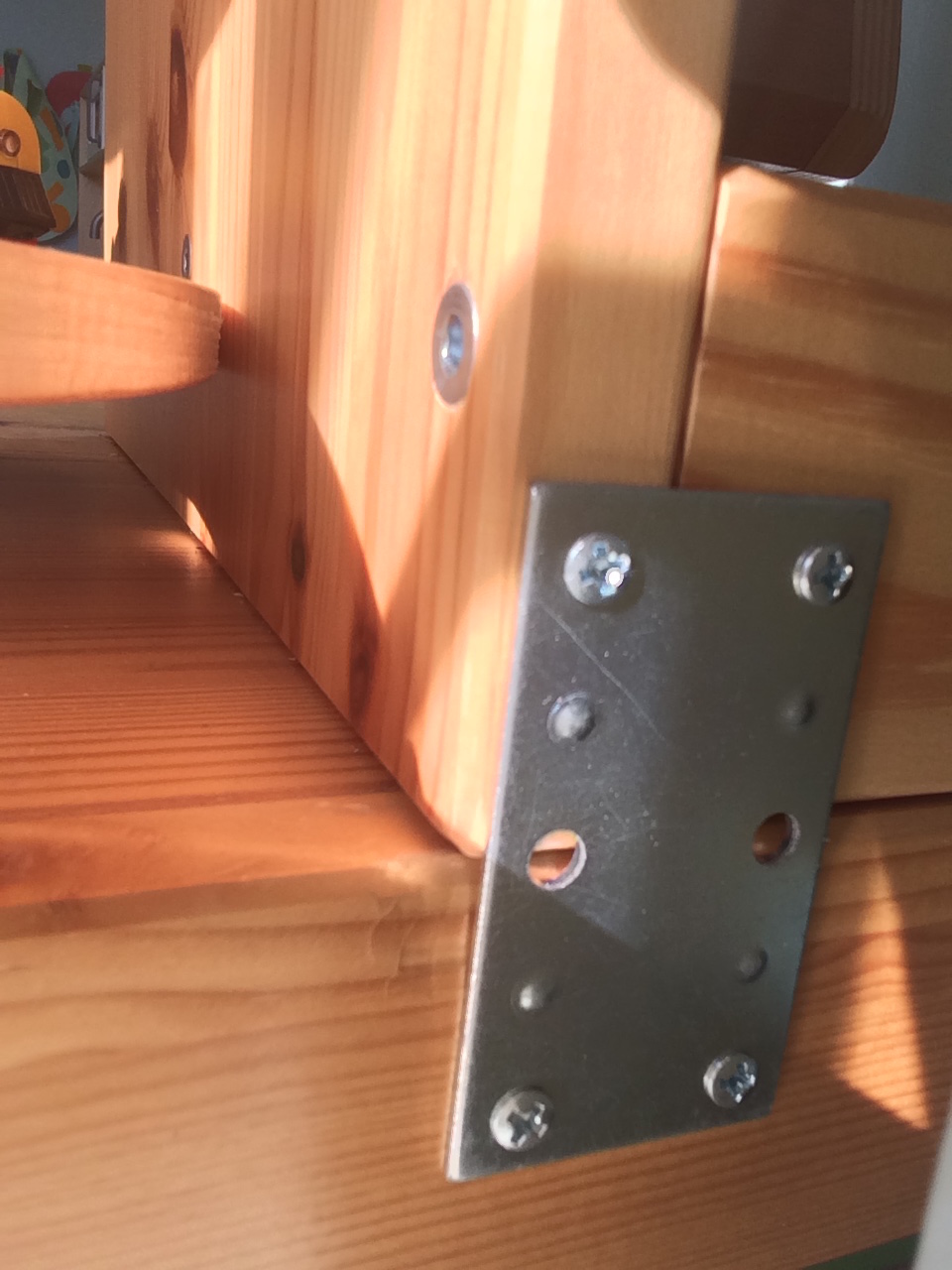
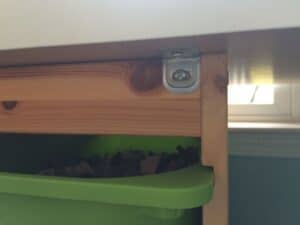
The desktop is attached to the two bottom TROFAST units with brackets and screws, and the TROFAST units themselves are all anchored to the wall. It is very sturdy. I have attached some images at the end of this post showing how the units are secured.
I have attached some images at the end of this post showing how the units are secured.
We have updated this space into a STEM Makerspace! See it here.
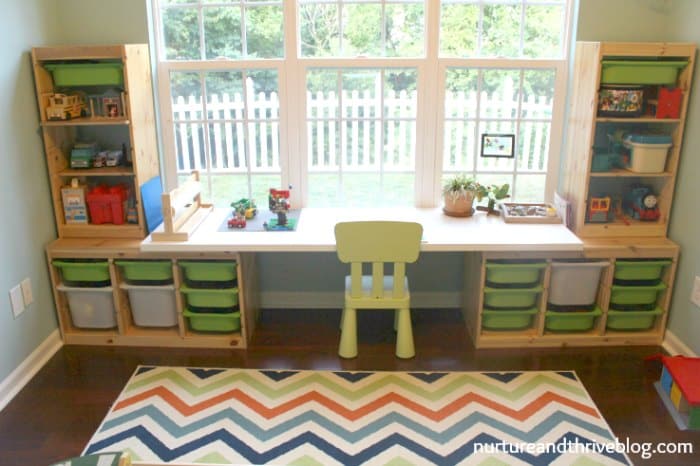
I also love having a bright paint color and a colorful rug to anchor the room. This (aff link) rug is an indoor/outdoor rug I recommend for playrooms because it wears well and is easy to clean. Also, when it’s colorful like this, you don’t notice the dried playdough as much!
3. More Play Areas that will Keep your Child Engaged for Years to Come
Imaginary and Pretend Play Area: This type of play lasts until about the age of 11 (1) and is well known to promote language and social development (2). This area of the playroom has evolved over the past few years.
We started with a play kitchen and dress-up hooks. We still have the hooks, but now they have superhero capes, and the kitchen has been replaced with this gorgeous (aff link) Teepee. This, by far, the one thing my son plays with the most and it gets the most use on playdates.
Click here for my tips on encouraging creative and independent play.
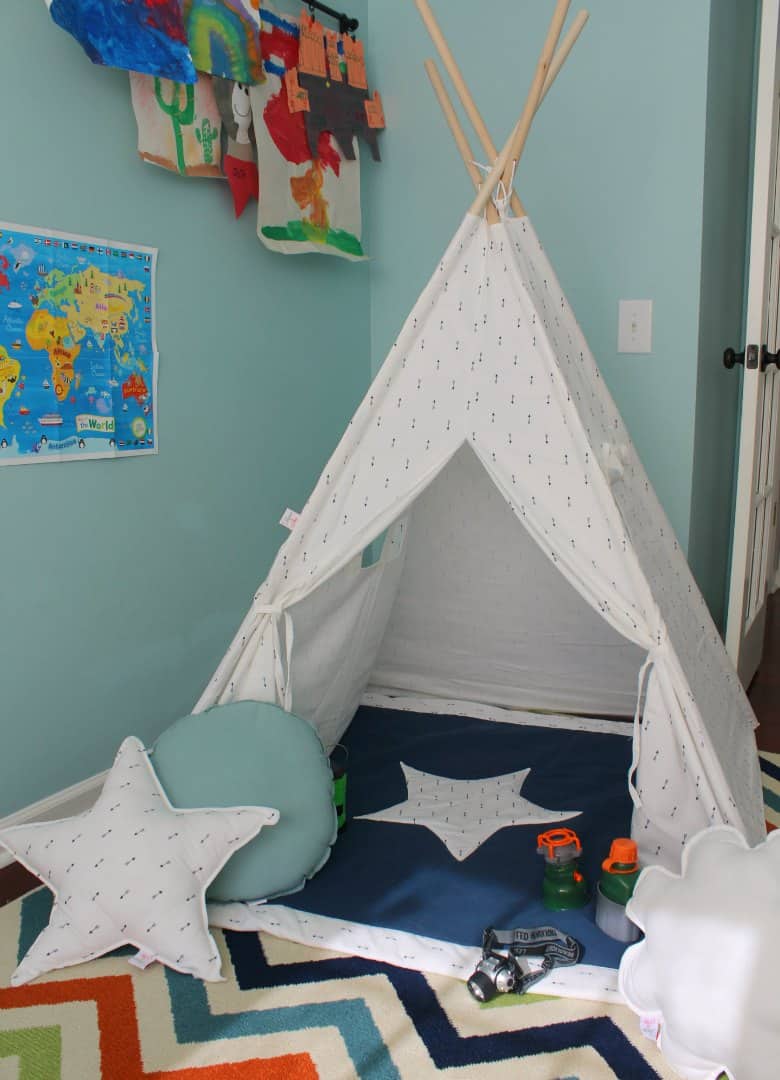
Building and Creating Area: Simple blocks provide another avenue of imaginative learning, which includes problem-solving skills, practicing physics, and divergent thinking (3).
We have several kinds of blocks, but my son’s favorites are (aff link) Duplo and Lego.
I imagine those TROFAST drawers will hold different kinds of building sets as my son grows. (See how I organize the Trofast drawers in my post on playroom organization).

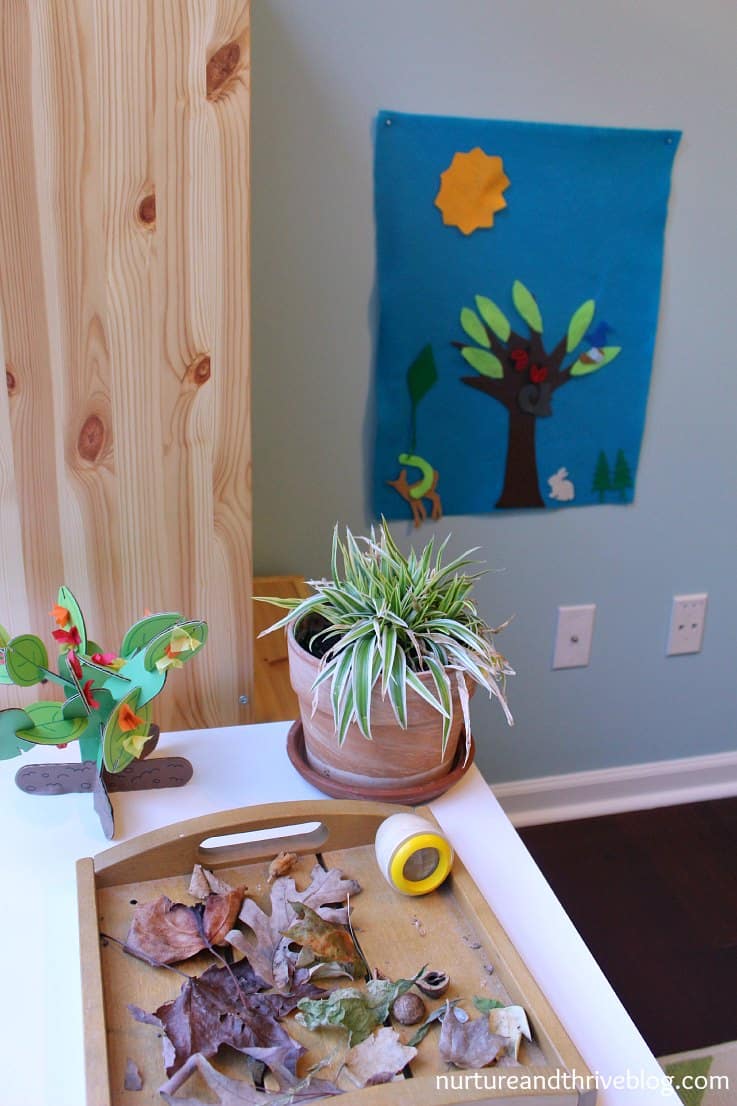
Nature Area: This is a way of connecting outdoor play to indoor play. Playing outside is absolutely essential throughout childhood — and nature walks are one of the best ways to do it. After your walk, kids can bring leaves, rocks, and seed pods back to a nature tray in the playroom to identify and explore.
In our playroom, we have a plant which my son chose himself (and named Spidey as it’s a spider plant). The weatherboard I made from a piece of felt. He has a little watering can that he uses to care for Spidey.
We also have a tray we use to put leaves, rocks, seed pods, and other things my son picks up on nature walks.
After our walks, we identify some of the things we saw, and I print out coloring pages of those animals or plants for his nature journal.
As he grows, I imagine the nature journal will include written entries and perhaps sketches.
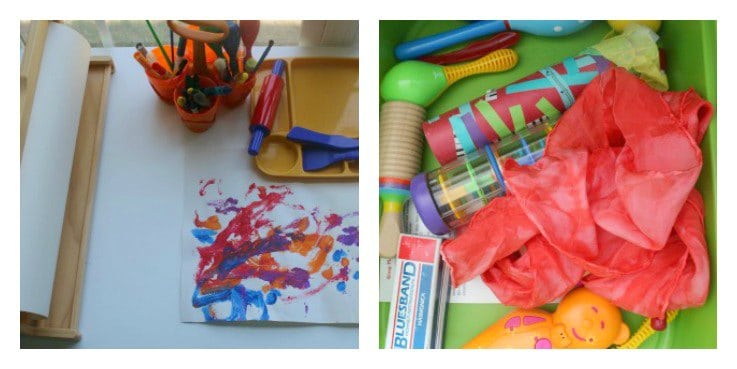
Art and Music Area: We have a few instruments in one of the Trofast drawers that are appropriate for his age. Maybe when he’s older, a guitar or some other instrument will have a home in this room. We will have to wait and see where his interests take us.
I keep our art supplies in a closet just off the playroom, in easy-to-carry bins and an art caddy (aff link). We also have this (aff link) art paper holder, which I love– easy to get just the size paper you want. Art and music are timeless and will easily grow with your child.
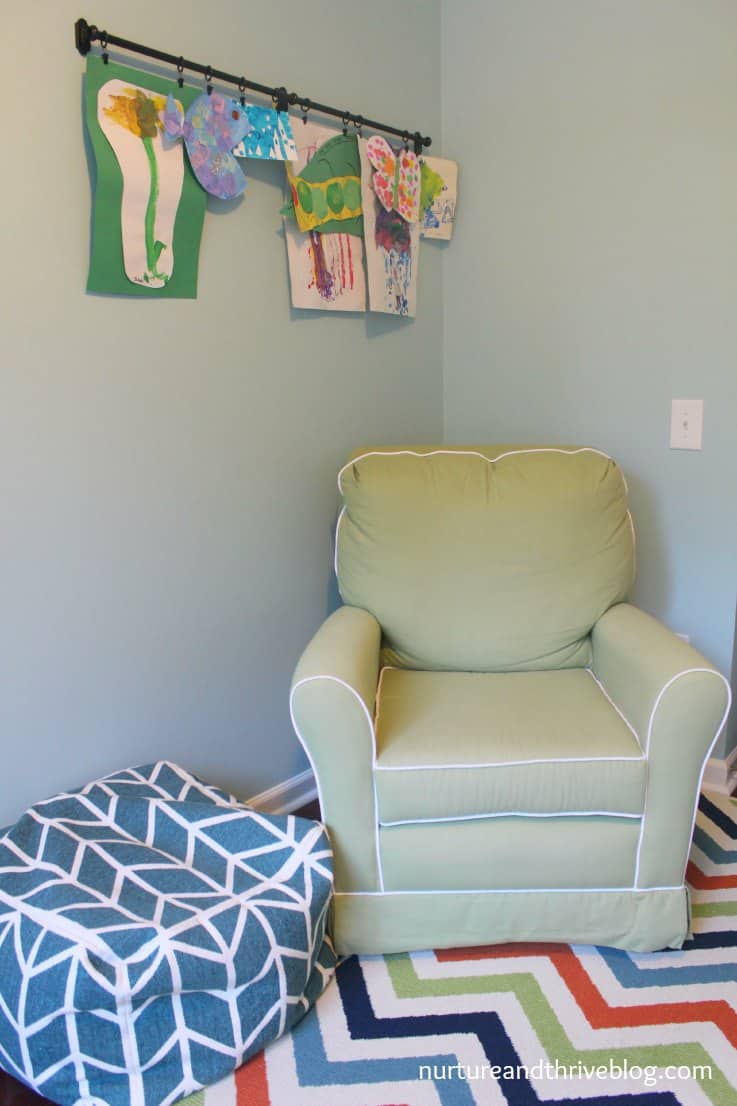
Hang Out Area: Originally, we had two places for adults to sit comfortably: a chair and a pouf ottoman. The pouf is great because I move it to the desk for art projects and to the train table for playtime —anywhere I need it.
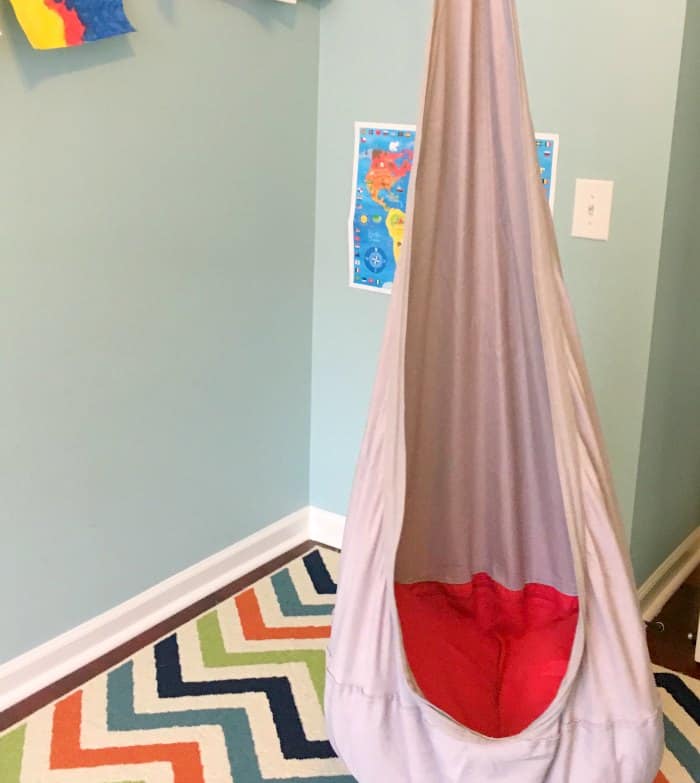
We have now replaced the big chair with a hammock swing similar to (aff link) this one. This is a great place to let off a little steam, especially for highly spirited kids, kids with sensory issues, or any kids who find swinging relaxing. It has become a place where my son often self-regulates and resets!
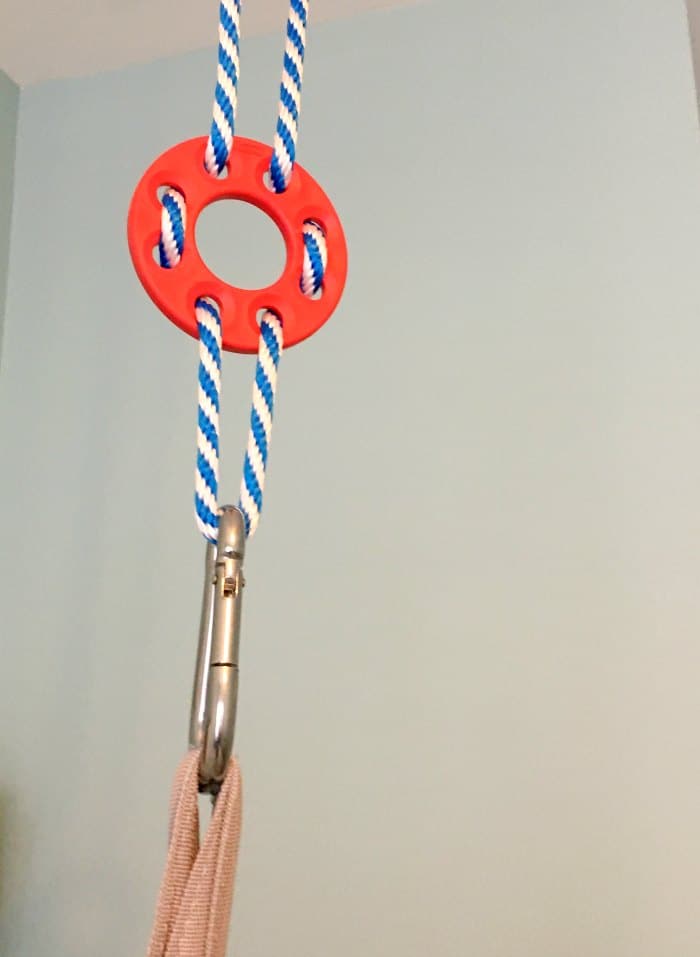
We have this attached with a weight-bearing carabiner so we can take it down whenever we need more floor space. A swing like this pairs beautifully with a calm-down corner — a dedicated space where kids can reset and reconnect with themselves when big feelings hit.
We have this attached with a weight-bearing carabiner so we can take it down whenever we need more floor space.
After having moved twice in a year, it is so great to start feeling settled in our home. Now, if only I could come up with a clever solution for my office space… that will have to be the next project! Happy Playing!
Update: I’ve had a few questions on how we attached the Trofast units. I’m attaching a picture of the back side of the units. The units are secured on both sides with a metal plate like this, and the bottom units are secured to the wall. The second picture shows how we secured the tabletop to the bottom shelves.
Decor Notes:
The paint color is Sherwin-Williams Watery (SW 6478)
References:
Smith, E.D., Lillard, A.S. (2012). Play on: Retrospective reports of the persistence of pretend play into middle childhood. Journal of Cognition and Development (4), 524-549.
Lillard, A. S., Lerner, M. D., Hopkins, E. J., Dore, R. A., Smith, E. D., & Palmquist, C. M. (2013). The impact of pretend play on children’s development: A review of the evidence. Psychological Bulletin, 139(1), 1.
http://www.npr.org/sections/ed/2015/02/06/384347659/behold-the-humble-block-tools-of-the-trade
What to do next…
1. Get advice from Dr. Ashley Soderlund sent right to your inbox. ❤︎
2. Give your kids a solid foundation for life skills!!
Get the tools you need in my shop! Digital printables you can instantly download and print to foster connection, emotion regulation, and more! Check out the Nurture and Thrive Shop.

 How to Get Your Toddler to Listen and Cooperate