
Last Updated on June 29, 2026 by Dr. Ashley Söderlund
Inside: Ten emotion-coaching phrases for parents. Our words can hurt or heal when our kids are upset. These 10 soul-building phrases will guide your child through their big emotions and help you be a source of calm when they are unregulated.
Childhood emotional development is rarely linear. A child may handle a major transition with ease one morning, only to be completely overwhelmed by a minor setback in the afternoon. These moments of intense reactivity often catch us off-guard because we expect a child to be able to ‘handle it’ based on their previous behavior. However, their ability to regulate is still under construction, and when they are tired or hungry, or feeling bad in some way, they may not communicate yet; their capacity to manage emotions diminishes.

It seems like the exact moments our kids are upset and need us the most are the ones we aren’t prepared for — the moments we ourselves are tired, stressed, sad, or triggered.
It’s exactly those moments that I feel like my words fail me — I search for the right thing to say, and it escapes me. It is also exactly at those moments when our children need us the most — to lead them through the emotion, through the storm — to be their emotion coach.
As one of my favorite authors says: “When little people are overwhelmed by big emotions, it’s our job to share our calm, not join their chaos.” – L.R. Knost

It’s our job to be accepting of the emotions while also teaching them how to handle them. Our words to our kids when they are upset can either break them down or build them up. These phrases will build your child’s emotional intelligence—soul-building phrases.
Download the Emotion-Coaching Reference Guide at the end of this post. Use this printable resource as a visual anchor to help you access healing language when your child’s emotions are larger than their capacity to regulate.
The Language of Connection: 10 Emotion-Coaching Phrases for Healing and Attunement
1. It’s okay to be upset — it’s good to let it out.
As your child’s emotion-coach, the first thing you want to teach them is that emotions are meant to be experienced, in fact, that their emotions need to be felt.
By doing this, you are both acknowledging how they feel, validating that feeling, and showing that the emotion itself, even negative emotions, are not something to be feared or avoided.
It seems like you are mad; it’s okay to be mad. It’s good to let that anger come out. Your face/body looks sad. It’s okay to feel sad. It is sad to say goodbye.
2. I hear you — I’m here for you — I’ll stay with you.
The best gift you can give another person is to stay with them through their emotions. To hold that emotion with them. That is something we must give to our children as well.
To simply be with them in that emotional space. To be there.
You are upset. Let’s sit here for a moment. I’m with you, I’ll stay with you — it’s okay to feel _______. I won’t leave you.
The key to holding space is being able to separate your child’s emotions from their behavior (here is how to do that) — we see the behavior we want to change and inadvertently dismiss their emotions.
3. It’s okay to feel how you feel. It is not okay to _________.”
Sometimes it is necessary to use a clear limit on how our child expresses their emotions. It isn’t the emotion that needs to change, but rather how they express it.
You look like you are really, really angry. It is okay to be angry. It is not okay to hit. I will not let you hit. Let’s go over here together, and you can be angry.
This is a very clear statement—hitting is not okay. As your parent, I won’t allow you to hit. I will help you regulate your anger. Being angry is okay, and hitting is not okay.
Taking a break when we are angry and walking away for a moment is actually a good way of regulating anger.
You are teaching your child to give themselves a little space to breathe and time to gain perspective.
During this time-in, you can coach your child through their anger and help them figure out a better way to solve their issue/frustration. Find more ways to help your child handle emotions here: The Heartfelt Way to Handle Tantrums and Meltdowns: Two-Step Mindful Emotions System.
4. How you feel right now won’t last forever. It’s okay to feel how you are feeling. It will pass, and you will feel better again soon.
In the moment, your child feels (and acts) as if their entire world is ending. Their emotions are big and overpowering, and they feel that they will never feel better again — which only compounds how they feel.
How many times has your child said, This is the worse day ever!
Ironically, 5 minutes later, they will be happy-go-lucky skipping by you while you are completely emotionally wrung out and wondering how you’ll get through the rest of the day. It’s as if that massive meltdown of epic proportions never even happened.
It is much harder for us as parents to be able to let it go — but remembering that their emotions will pass will help.
And reminding them that their emotions will pass will help them, too, potentially lessening the intensity of those emotions in the first place!
5. Let’s take a breath, take a break, sit down, and pause for a minute…
It is a hard thing to do to sit with an emotion. To just feel it — live in it. But if we allow ourselves to be in the moment with our emotions, we can let them go more easily.
They don’t fester deep inside until they get so big they explode out of us again.
I love this quote from Mister Rodgers when he spoke to a group of parents about grief:
There is one thought that I feel can be helpful to grown-ups and children alike: Sadness isn’t forever. I’m not suggesting
Mister Rodgers
that we remind ourselves of this in order to lessen our grief. On the contrary. The knowledge that time does bring relief
from sadness and that sooner or later there will be days when we are happy again may allow us to grieve more fully and
deeply when we need to.
A key part of being your child’s emotion coach is simply teaching them that experiencing and feeling the emotion helps us to let it go. It may return — over and over — but if we allow ourselves and teach our children to notice it, acknowledge it, feel it, then we are releasing it instead of shoving it deep down inside where it will continue to hurt.

We can teach our kids that when emotions are big, it’s okay to sit with them for a minute. You can sit quietly, or you can ask them how they feel.
Or, perhaps even better, you can describe how feelings feel to you, thereby building their own emotional intelligence. They may relate or change what you say with their own descriptions as you talk.
When I feel that upset, I feel like I can’t catch my breath, so I try to breathe slowly. Sometimes I feel a little embarrassed, too, and a little hurt. I feel like my heart is a bit bruised. After a few minutes, my heart feels better, and I feel like I can go on with my day.
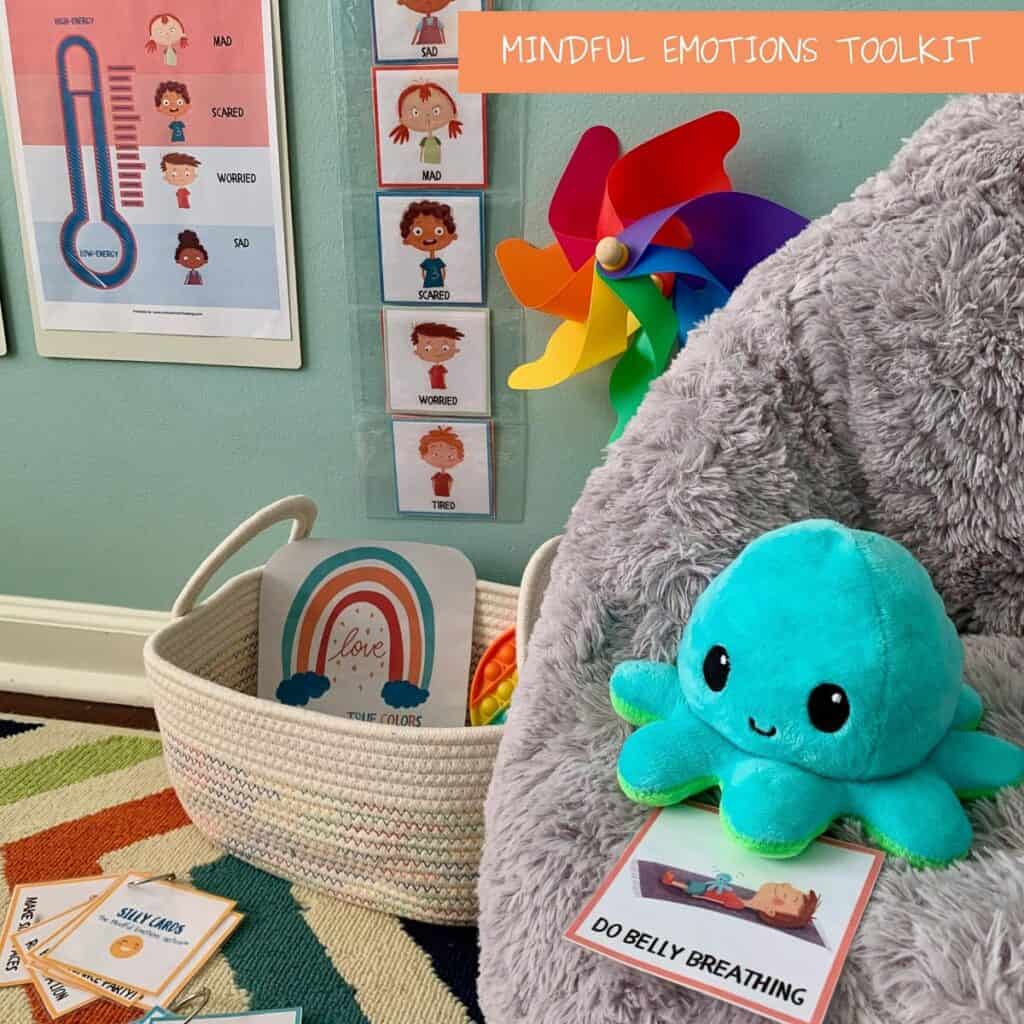
For younger children, especially, using tools that will help them identify their emotions is powerful. Emotions are abstract, and children, even adults, find it hard to describe them. This printable toolkit has several tools to help children identify emotions and a set of regulation cards to help them work through big emotions.
6. You are good and kind.
Being dysregulated is not being bad. Being angry or frustrated is not being bad. Yet, sometimes, when we are emotional, we don’t always make the best choices.
Our kids may make mistakes or bad choices, but that is how they act, not who they are. This is such an important message when we emotion-coach our kids.
Research shows that telling children they are kind leads to more generosity. We want our kids to know that, no matter how they feel, they are good and kind.
You were angry. You didn’t mean those unkind words about your brother. Sometimes we say things we don’t mean when we are mad. You are a kind boy. What do you think would make your brother feel better?
This also helps our children with their friendships. Young children like categories and labels — it’s part of how they think.
They may label another child as “bad” because of something that child did — maybe it was impulsive — maybe they didn’t think before acting — maybe they were emotional and made a bad choice — but they are not “bad.”
This is an important distinction to learn in early childhood.
7. I’ll be over here when you need me.
I am all for validating and acknowledging children’s emotions, but sometimes kids escalate their emotions for attention. This is a big clue-in for parents that your child needs some one-on-one time. But not right now, later when things are calm again.
How do you know when it is an escalation? When your child refuses a hug or comfort and cries harder. Or when all the tactics that usually work fall flat.
Giving unending validation and acknowledgment at times like this can backfire, potentially even enabling the tantrum or escalation of emotion. This is when the classic time-in can be ineffective. That is why I recommend the flexible “Feeling Break,” which is a variation of time-in, but also works when emotions escalate with comfort — or when you need a break — parents have emotions too!
You can still acknowledge your child’s emotions while giving them a chance to regulate themselves. “I can see you are really upset about this. It’s okay to be upset. It doesn’t seem like what I am saying is helping. You remember what to do when you’re upset, and you remember how to calm down. I’ll be over here when you need me.”
You aren’t abandoning your child with their emotions; you are trusting them to put some of the strategies in place that you have taught them.
You also make a note that they need attention, you make sure to do that later that day — have some quality one-on-one time and reconnect. But right now, it’s okay to give them space to regulate.
They may ask you to come back, and that’s fine. After a short while, you might check on them and ask if they need a hug. Or, they may just need a little time on their own — we all do sometimes!!
8. Let’s have a Do-over!
Oh, how I love do-overs !!
Here’s the scene: You’ve planned a fun activity. You are so excited!! You are trying to get everyone out the door — emotion and excitement are high. Something happens — now your husband is upset — your child has acted out — the kids are fighting, and you are so disappointed. ):
Whoa!!! This is not the fun we had planned for today! This is not fun for anyone. That was not the way to handle that situation, was it? She didn’t mean to hit you in the eye with her coat sleeve, and you know it’s not okay to hit ever. Let’s have a do-over!! Let’s try it all again!! How can we do it better this time??
Sometimes everyone needs a chance to reset.
A do-over is not always appropriate, for example, if feelings have been deeply hurt, a do-over can be dismissive of the person with hurt feelings.
But, so many situations are little tiffs that we let get under our skin that pile up and become more and more frustrating.
Give your family a chance to do it over and start out on a good — or on a great note!
9. What can we learn from this? What is the lesson in this?
Teaching our children that there is a lesson to be learned when we struggle is so important. There is a lesson in our pain, disappointment, and anger. Those problems that are hard to solve lead to opportunities.
It is through the mistakes that we grow.
This is not just true for academic situations or achievements. It is true for relationships, for friendships, for dealing with hard social situations.
It is true of things that make us feel sad, things that make us doubt ourselves.
What is the emotion trying to tell us? Maybe we handled a situation wrong. Maybe to try again and not give up. Maybe not everyone is a good friend. Maybe that we haven’t been good friends and that we need to apologize.
Emotions are not just random things that happen to us — emotions are lessons — emotions are the fabric that connects to the ones we love.
10. You’ll Remember Next Time.
When your child does something they shouldn’t do, and you correct their behavior– say this. Or when you’ve worked through a tantrum and taught them better ways to express their emotion, before they go onto the next thing, say, “You’ll remember next time.”
That one simple phrase communicates so much to children. It tells them that their failure today isn’t a permanent failure and that they can change.
It gives them something positive to focus on: “You’ll remember next time to use your words.”
It also helps them resolve their current feelings (I feel bad now, but next time I can do better) and gives them a sense of relief and a desire to try next time.
If they do remember next time, they might even point it out to you, “I remembered Mama! I used my words!” with their eyes shining with pride. And you’ll respond with a “Yes, you did remember! You used your words!” just as excited as they are.
When they do that, you know it happened — they were empowered to change their behavior from within.
Join: Me on Instagram to get more tips!


 Four Ways to Raise a Critical Thinker: Teach Your Child How to Think, Not What to Think