
Last Updated on June 20, 2026 by Dr. Ashley Söderlund
Inside: Imagine having fewer power struggles with your child using this 3-step positive parenting system that separates feelings from behavior. Acknowledge your child’s feelings while still setting limits. Instead of micromanaging or controlling, positive discipline focuses on the parent-child connection.
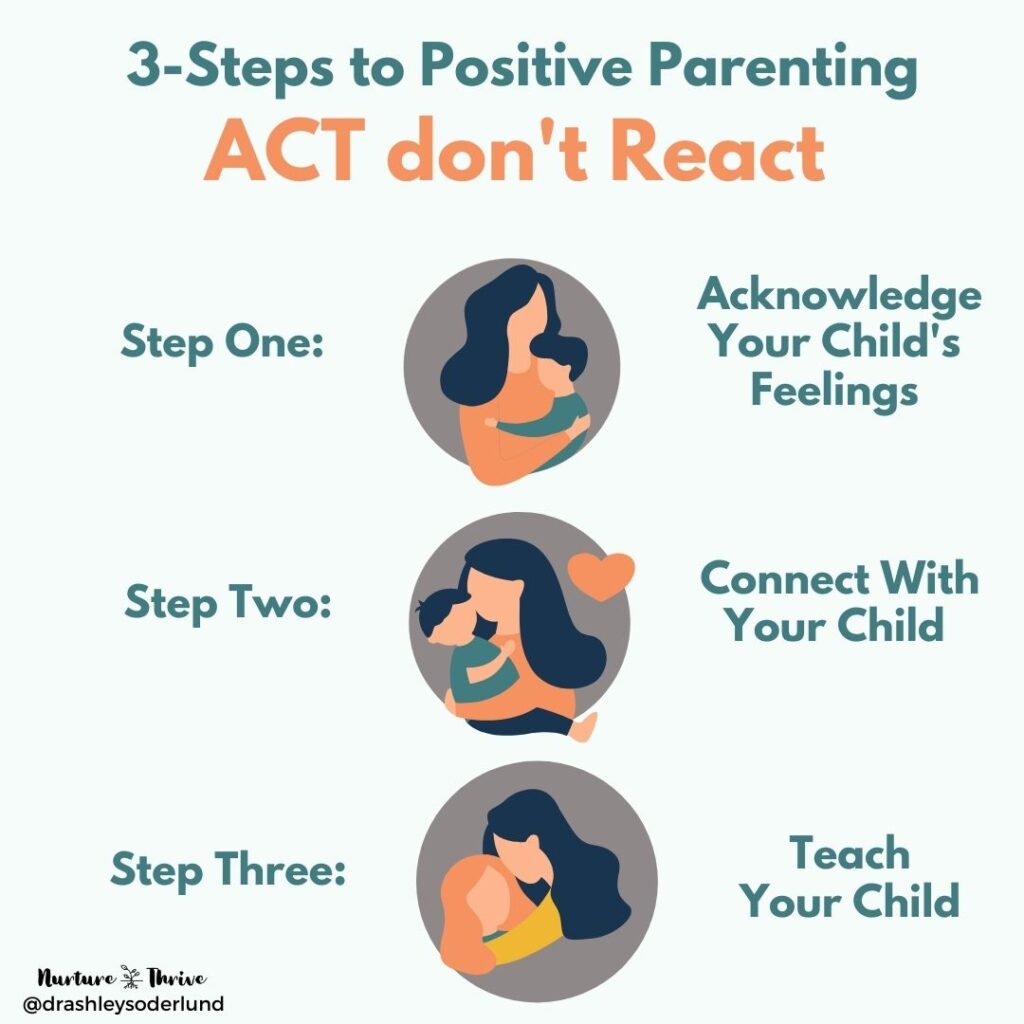
We all have the best intentions, and yet, regulating for yourself and a little person is really, really hard. It is exactly those hard moments you look back on and wonder why you didn’t use all of the strategies you’ve read about — strategies you agree with! Well, first, no one is perfect. And wouldn’t it be weird if you were raised by an absolutely perfectly regulated person? I think children learn when they see us make mistakes and then relationally repair. And second, it is hard to remember any kind of strategy when your brain is flooded with your child’s and your own emotions. That’s why I developed an easy-to-remember three-step system A.C.T. Framework: Acknowledge, Connect, and Teach. This helps you ACT intentionally and not react when your child is upset.

3-Step Positive Parenting Program: Respond (A.C.T.: Acknowledge, Connect, Teach) instead of Reacting
Step One: Acknowledge Your Child’s Feelings
The first step in changing your child’s behavior (to positive discipline) is to be empathetic with what they are going through. To do that in a concrete way, we first Acknowledge what they are feeling.
Acknowledgment of emotion is a keystone of positive parenting.
How to Do it: Acknowledging Feelings
Get eye-level with your child and ask them how they are feeling. With younger children, you can name the emotion for them. At first, ignore the behavior or expression of the emotion — simply help your child identify the core feeling.
“I see you are trying to get a reaction from the puppy with your truck. Are you wanting to play with her?”
“I see you are being rough with your friend on the playground. Are you feeling really frustrated?”
“I see you are upset that it is time to go. Are you feeling sad about leaving?”
Listen to their response and then empathize with them. You can say things like, “that is hard”, “that is upsetting”, “that is sad” or “I’ve felt like that before too.”
Acknowledging children’s emotions helps them understand emotion, leading to better empathy and prosocial behaviors, especially in boys. Talking about emotions is also associated with more sharing and helping behaviors in toddlers.
When you start this conversation about emotions, you are listening to their hearts. In response, they will feel like it is safe to express those emotions to you. Coaching your child through their emotions will help them build the foundation for emotional intelligence and regulation.
Step Two: Physically Connect To Help Diffuse Your Child’s Emotions
After you Acknowledge their feelings, it is time to physically connect with your child, which helps give their emotions a place to go.
Connecting with your children first, before correcting the behavior or asking them to change the behavior, will make it much more likely they will cooperate.
The key is to show your child that you accept them, even when they have big emotions. You do not need to accept their behavior, but you accept who they are and how they feel. This acceptance is a key component of positive parenting.

How to Do it: Connecting With Your Child
The balance between offering co-regulation and maintaining boundaries is a clinical challenge I first explored in-depth for Slate (see: When to Give Crying Kids Comfort). This concept is a core pillar of Step 2 in the Heart-Mind Method.
While rubbing your child’s back: “It is hard to wait. I think it is hard to wait sometimes too.” (Here you are empathizing, normalizing the emotion, and physically connecting– “I’m here with you”).
“You are really frustrated. Would you like to stomp like a dinosaur? How about a hug?” (Here, you are offering a physical way to release frustration and a physical connection).
“You are upset that we have to go. Would you like a hug?” (Here, you are diffusing their emotion through a stress-relieving hug).
Hugs can be powerful. They have been found to buffer against stress, especially hugs from mom.
Acknowledge and Connect often happen at the same time. As you acknowledge your child, you also give them an outlet for that emotion through you. You help them channel that emotion. This is also laying the foundation for emotional intelligence.
By naming your child’s emotions and connecting with them, you are teaching them healthy ways to handle their emotions- not to bottle up or act out on them, but to express and share them.
Connection sometimes becomes harder as kids grow up. I cover this topic of staying connected in my post about positive parenting and teens.
Step Three: Teach Your Child Positive Behavior and Healthy Ways to Express Emotion
Now that your child has been acknowledged and feels connected to you, this is the time you can teach them what they can do next time.
This is why the A.C.T. method of positive parenting is so effective — you give your child the tools to know what to do next time. “Discipline” isn’t about punishment or instilling fear; it is about teaching, providing ways to handle emotions, and figuring out how to get along with others.
The original meaning of the word discipline comes from the Latin disciplina, meaning “teaching, learning,” and is related to the word disciple.
As parents, then we are teachers. Getting your child to change their behavior is all about presenting it in a way that empowers them to want to change — this is what “discipline” looks like in positive parenting.
When children feel empowered, they will be internally motivated to change their behavior rather than you externally controlling it through threats and fear (which, spoiler alert, doesn’t work).
Additionally, when your child is in a reactive state, lecturing won’t help either. According to research, negotiation and reasoning are the most effective discipline strategies in most situations.
How children act out changes with age. From about 18 months to 5 years, direct defiance decreases, while simple refusal and negotiation increase with age. 5-year-olds who used negotiation more often, as opposed to defiance or refusal, were less likely to develop psychological behavior problems, like externalizing disorder.
The strategies used in positive parenting, negotiation, reasoning, giving choices, and compromising within limits are all effective in the here and now and help build the foundation for your child’s ability to solve problems in the long term.
How to Do it: Teach through Negotiation
“We need to go; we had so much fun! Choose one last thing to do, and we’ll go. Let’s stay longer next time. Next time, I’ll give you an extra warning so you know it’s time to leave, and I’ll make sure we get there a little early so you have more time to play. What will you do next time when it is time to leave? What is our new good habit? We will choose one last thing to do!”
How to Do it: Teach through Reasoning
“What would happen if we were always loud around the puppy when she was eating? What if someone scared you when you were eating?” My son “Maybe she would stop eating.” “Yes, and then she would get sick, right?” My son: “Yes, I don’t want her to get sick.” “I know you don’t, but now we know what to do when she’s eating, don’t we? And you’ll remember that next time. You will be the person to make sure everything is calm when she eats. That can be your job!”
How to Do It: Teach through Taking a Break
“We cannot push and shove on the playground, even when frustrated. What can we do with our frustration? Can we stomp our feet? Wave our arms? Throw away our angry ball? Let’s take a break together over here until we feel better.”
How It All Works Together: An Example Using the ACT Method of Positive Parenting
Sometimes Acknowledge, Connect, and Teach will happen almost simultaneously.
Imagine that your child is hitting another child on the playground. You walk over and firmly grab their hands, stopping the behavior (Connect) while at the same time you say, “I can see you are angry” (Acknowledge), followed by Teach, “It is okay to be angry and stomp like a dinosaur, but it is not okay to hit. Let’s take a break on the bench together.”
Related Reading: Time-out vs. Time-In: Is There a Better Way? Why You Need the Flexibility of a Feeling-Break
Kids are good at letting go and moving on. We are not; we tend to linger on difficult interactions. For me, I think I linger because I question how I handled it. With A.C.T., you’ll have more confidence in your actions, which will help you stay calm and cool that inner critic.
When you think about responding to your child proactively, you’ll find that these moments become the foundation for the social and emotional tools your child will use for life.
When you ACT instead of REacting to your child, you are helping learn how to solve problems. You are teaching them that they can change their behavior.





 Time-Out vs. Time-In: Why Your Child Needs the Flexibility of a “Feeling Break”
Thank you Ashley, especially for the last part about letting go of the interaction. It is so hard to do when you are still processing things, trying to justify the way you handled things…
Exactly– that’s my issue as well. I dwell on it. Best to let it go and have a plan for next time!
With an older child (7yo) what do tou do when they deny what you are trying to acknowledge as their feelings? And refuse to connect so you can get to the teaching?
Great question, Jenn. If they say to you, “you don’t understand me!” — try thinking of a similar situation that you have experienced. For example, if someone hurt their feelings at school, you could say something along the lines of – “once my friends didn’t invite me to their lunch date and I felt left out.” They might say, what did you do? And you can say that whatever you did – like you talked to your friend afterwards and told them how you felt, for example.
Connection with a 7-year-old, may be more verbal. Take the above example – even if you friends hurt your feelings, you know you can always count on me. I’m always here to listen or give you a hug.
Another thing with a 7-year-old may be actually telling them that while you may not agree with their behavior, you can understand why they might feel how they do. Then give an example of how you have felt that way. “I may not agree with how you handled this situation, but I can understand that you were feeling frustrated and that’s why you did that. Let’s talk about another way to handle that situation.”
Email me if you have more questions!
Thank you for this article. Love the acronym! Love the last bit “you don’t have to change their behavior for them or control them, you have to understand them and help them handle those big emotions.” that is so true. Thank you!
Thank you Tiffany! I am so glad to hear that. It makes my day!
May be we are to busy or stressed a bit , therefore without our knowledge we tend to react. This ahppens most of the time . Thanks for making aware…..
This article really helps to give perspective on dealing with these difficult situations – especially with all the examples you’ve included. The way you’ve presented it, the ACT method feels workable – even in the heat of the moment, which is, of course, when it’s vital!
As you say, all three elements naturally happen in quick succession, sometimes even simultaneously (so may there be the occasional appearance of a CAT?!). These excellent strategies have wider applications too: I’m now inspired to see if I can remember to ACT in certain adult interchanges (with a little judicious modification here and there). Thank you!
I’m so glad is resonated with you! Thank you for your comment. And yes, the challenge is remembering even in the heat of the moment — that’s my challenge as well!
I really appreciate your articles. As I was reading “A 3-Step System for Positive Discipline”, I was not sure to what level do you keep calm. Sometimes, when I use the (connect+teach) startegy, my 7 years old tries to manipulate the situation and blame other persons or things than herself.
Thank you for your comment! So, in my article, How to be a Calm Parent, steps 1, reframing and 2, centering happens before you engage in discipline. Step 3, have good tools is where this article comes in and you start the three steps of positive discipline.
In reality, it happens rather fast. So, step 1, reframing, involves observing your daughter. Why does she feel the need to blame others? Is she anxious about the outcome of discipline? I often tell my son, “it’s okay to make mistakes and we can learn from those, but if you lie about it I can’t help you.” I also show him I’m not mad, just helping him with his behavior and emotions. Come at it from a “I’m helping you learn about behavior and how to get along with others,” or whatever best fits the situation.
This book is also great and may give you more ideas for 7 year olds, (aff limk): How to Talk so that Kids Will Listen and Listen so that Kids will Talk.
I hope this helps!